
All About Me
The White Mosque by Sofia Samatar

Students and readers alike lament the poverty and tedium of academic writing. A common conclusion is that academics ought to spurn their status-seeking jargon and instead try to write like novelists. This book suggests that while that has advantages, it can also prove a mixed blessing.
Sofia Samatar is a prize-winning novelist and an academic, and this book sits somewhat unsteadily on the three-legged stool of memoir, travelogue and monograph. The memoir parts are generally open-ended and slightly tedious questions of the divided self, Samatar being a mix of race and religion, and so on. It suffers from the fundamental tedium of hearing at great length about another’s genealogy.
The travelogue is thin and largely structural. It gives shape to the voyage across central Asia of a coach load of Mennonites, following the trail of a long-ago Great Trek.
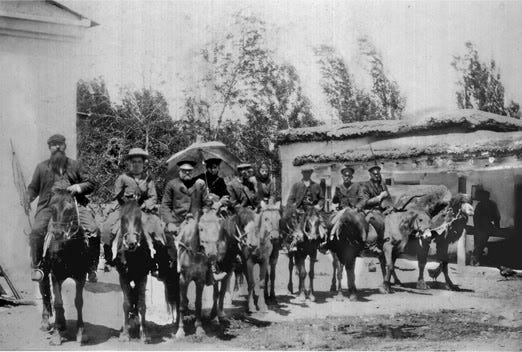
That was an episode in which German-speaking Mennonites, inspired by a rogue preacher, Claas Epp Jr., fled tyrannical Russia and travelled to Khiva, Uzbekistan, where they built a totemic whitewashed church in Ak-Mechet and awaited the apocalypse that Epp had promised them.
The historical story is intriguing. And it’s more readable than an academic treatise would be, no doubt. But the book is also undisciplined.
The reader grows a little tired, within the first sixty pages, of the incessant first-person pronouns and, to be technical, possessive signifiers. ‘My history’, ‘my faith’, ‘my story’ (to which the reader adds ‘my boredom’).
But then things get into gear, and the grand historical narrative begins. It’s a cracker: a tale of desperate travel across the steppe in wagons, the terrible deaths by distemper and disease of so many Mennonite children, the eventual hardscrabble establishment of an alien community, and the great disappointment that came when the world did not end.
After that, it seems, some of the Mennonites scattered, some ending their lives almost a century later in far-away Saskatchewan. Epp stayed on, declared himself the son of God, and is largely forgotten by history. The remainders were later collectivized by the USSR.
All this is nicely laid out in Samatar’s book. And from her, we learn a lot about the locals, too: the food they ate and still eat, their material culture, their languages.
The book is the product of years of obsessive, magpie-like work and is deeply researched.
It is full of little oddities and strange people. For example, Ella Maillart, the Swiss woman traveller on her bicycle, who practically measured central Asian heads with callipers in her cheerful adherence to the verities of race science.
Or the story of Drake, a boy who attached himself to the Mennonites, and who was taken by vapours or madness and disgraced himself by singing a Prussian military anthem in a strictly pacifist church. He then tried to redeem himself by swallowing, literally swallowing, a testament, which had to be pulled from his bleeding mouth.
Samatar has a nice detour into the hitherto under-documented origins of Uzbek photography. Another on the time Langston Hughes, the great black poet, ran into Arthur Koestler, then a believing communist, in Soviet Uzbekistan.
In keeping with her general meditations on her religion, she both enjoys and recoils from the pornographic and self-mythologizing Anabaptist book Martyrs Mirror, whose full title begins rather aptly, The Bloody Theater.
As the name implies, and in the old tradition of Eusebius and John Foxe, it treats of the persecution of the Anabaptists – whose number includes Mennonites. Their torture and their senseless killing. Burnings and scourings and the rest. It does so with a relish and a glee. In its telling, Anabaptists are both the most victimised group ever to walk the earth and also God’s only anointed inheritors.
It’s a claim many Christian sects still make as they give their children pop quizzes on martyrdom of a Sunday afternoon.
On Samatar’s part, these are nice details and vignettes, picked up from memoirs and film archives. Something a novelist can give life to, which an academic might render sterile.
But this book is also, to my taste, overstuffed.
This is no doubt a question of preference. You may find description like the following apt and evocative: ‘we all have this desire to hoard the honey, its creamy weight, its slight graininess on the tongue, its alchemical power that transforms a morsel of bread into gold. … Eating this honey requires everything of you.’ I find it excessive and purplish, almost disgusting.
So we are left with a quandary. How to characterise this book? As a collection of historical anecdote, it’s first class. As the account of a coach trip, it’s fairly banal. As a theological and racial memoir, it’s dull and occasionally maddening.
But it’s better than a dreary academic study of the same subject, which would rob the Great Trek of its central, wilful madness and the deep, desperate desire common to all religious pilgrims: to believe and keep on believing – even as the children die one by one and must be buried in the desert; even as the border guards prove troublesome and violent; and even as the end of the world – long promised by our preacher – twice fails to arrive.