
Dramatic Irony
Poems by Heinrich Heine, translated by Julian Fane

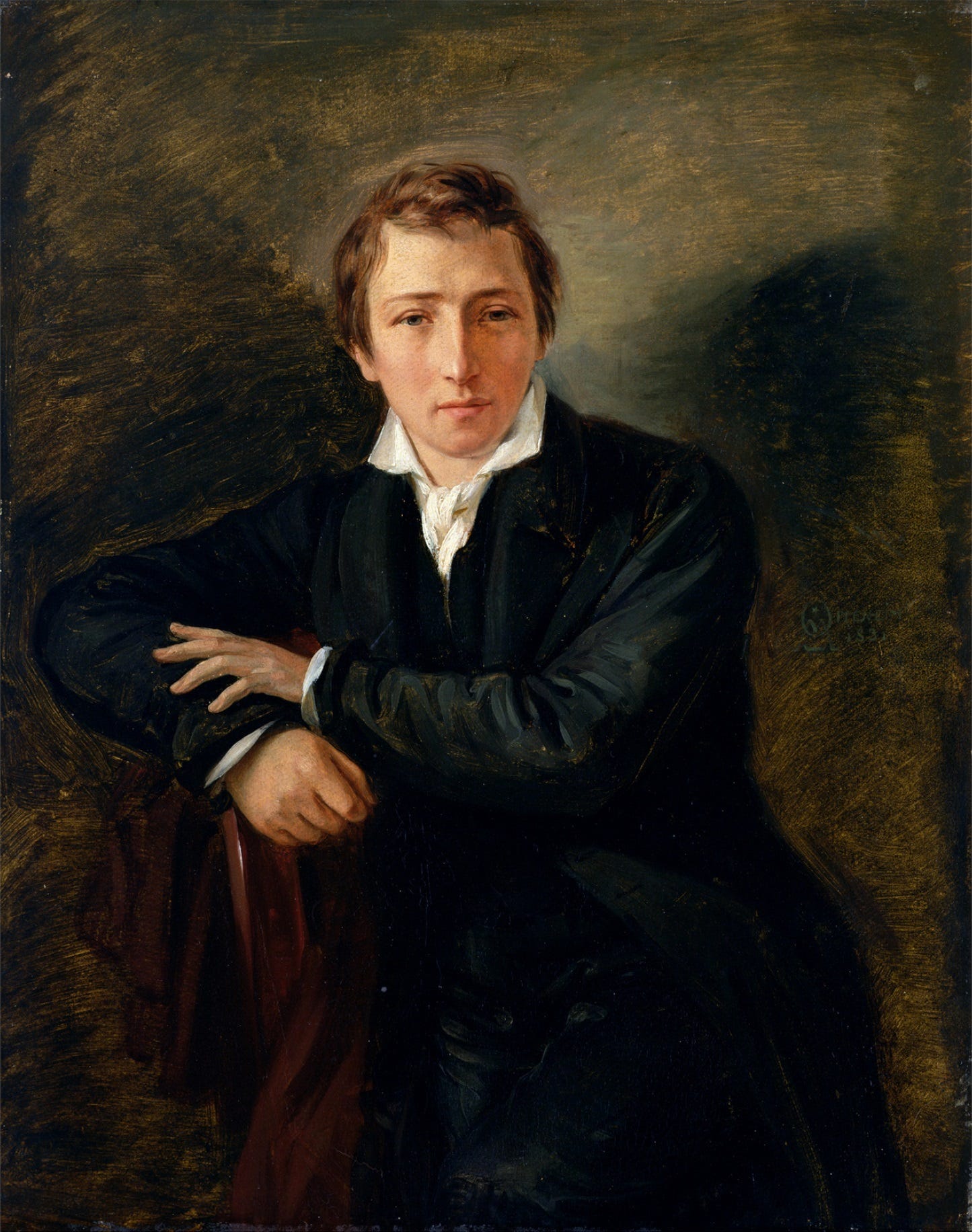
My German is underdeveloped, and thus any commentary on the fidelity of Julian Fane’s translation is likely to be brief and circumspect.
But I can say that this strange little volume kept my attention.
In part because of the historical subject matter of “Battlefield of Hastings”, but also because of the possibility there is to spot the analogies that Fane — a diplomat in Vienna — made to English poets who tackled similar things.
Cursory reading indicates that Heine is at least partially known for his great wit and irony. Of that, there is in this book little evidence. Instead, I’d say, he would better be characterised by this selection as a doomy romantic — of a piece perhaps with half-remembered Wordsworth on natural subjects, and Keats — in a minor phase — on love.
The history first. It closes this volume, but the Hastings poem is worthwhile enough to be discussed first. The subject matter is entirely romantic. It takes the legend of Edith the Fair — known also as Edith Swanneck — an old flame of the king’s, searching for Harold, her former lover, on the remnants of the battlefield. She does this because no one else could identify his body.
According to legend, and according to Heine too, she was accompanied by monks from a nearby abbey on her search.
“Hither then to the Abbey-church
“Do ye the body bring,
“That we may yield it Christian rite,
“And for the soul may sing.”
There is the ordinary pathos of one lover identifying the corpse of another, but it’s accentuated by Harold having thrown over Edith for someone more queenly quite some time ago. Not only is he now gone, but they have grown old apart from each other.
No word the swan-necked Edith spake;
Her cloak about her cast,
She followed the Monks; her grizzly hair
It fluttered wild in the blast.
In these stanzas, and across the collection, some word choice is suspect. ‘It fluttered wild’ is hardly elegant. But ‘grizzly’ hair to emphasize love’s lost time: I think it’s a small touch of brilliance.
The result:
Discovered hath Edith the corpse of the king!
No longer need she seek;
No word she spake, she wept no tear,
She kissed the pale, pale cheek.
To judge by this selection, Heine had a romantic view of his subjects which was quite expansive — petals and knights enmeshed in the supernatural, and dark Thanatos appearing periodically.
“The Haunted Knight”, in this version, clearly aims for irony but manages only subject-matter romance, or sentiment. We are introduced:
There lived once a knight who was silent with woe,
His ashen cheeks furrowed with seams;
Tottering , swerving and reeling he'd go,
Quite lost in his dreary dreams.
So wooden he looked , so clumsy, so daft —
The sweet little maids and the flowers they laughed
As he stumbled along with his dreams.
‘With all human kind he had broken’, we are told (a circumstance just missing its Belle Dame), so that when, at the midnight hour, his love arrives to meet him, the reader is already primed to distrust.
The loveliness of this Fairy, as we are told she is, is so assured, and its affect on the knight so galvanising, that we know the ending already. The knight’s isolation ends, and the two dance. They reel around with joy, and by the Fairy’s magic the two are to be married.
You know what happens next.
So sweetly they sing, and so sweetly they play,
And dance on their light feet airy!
The knight feels his senses passing away,
And closer he clasps the Fairy —
Sudden, the Lights all fade into gloom;
And the knight sits alone in his lonely room,
In his gloomy Poet's chamber.
A few nice phrases, no doubt, but perhaps it is pithier in German.
I will conclude with something I found truly amusing, set amid the Miscellaneous Poems.
‘I called the Devil and he came’, Heine says, and the form it took was attractive.
He is not ugly and is not lame,
He is a charming gentleman,
A man just in the prime of age,
Courteous, travelled, bland and sage.
Here is the funny part: ‘A Diplomat he is, first rate / Discoursing well of church and state’.
And the comic-horror begins: ‘And pale he looks, and looks not well, / From studying Hegel down in hell.’
He praised my endeavours to study the Law;
He himself at the same task had formerly plodded.
He said that my friendship, for aught that he saw,
Would prove to him precious …
(Ambrose Bierce reminds us in his Devil’s Dictionary that a liar (n.) — of which the Great Deceiver likely is — can be defined as a ‘lawyer with a roving commission’.)
The narrator continues…
— and thereby he nodded,
And asked, with an evident wish to caress me,
If we had not met at a ball in West-end?
And when I looked straight in his face — Heaven bless me!
I recognised in him a very old friend.
And Satan is known to be a companionable sort, after all.