
Fifty Swamp-Bound Years
The Prince of Darkness by Robert D. Novak

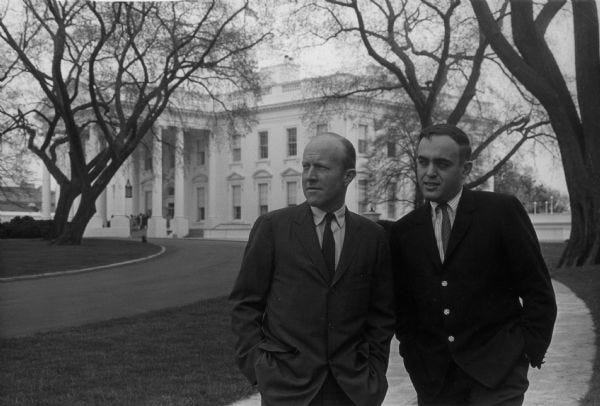
Robert Novak’s autobiography is a strange beast — just as, it seems, was he. The co-author of a short column of reportage for over forty years, Novak met essentially everyone of note and covered almost everything of importance. He had twenty-five years in cable news which happened to coincide with the medium’s first twenty-five years. For most of his memoir, he comes across as funny, big-hearted, and straightforward.
He stressed that he and his co-author, Rowly Evans, were reporters. His day-to-day involved endless meals with sources, continual phone calls, and traipsing around not only the continental United States, but on occasion around the world in the pursuit of reporting. And yet, and yet, in this memoir littered with press clippings (many of them rather good, and a few of them prescient in the extreme) it is a surprise how few scoops of any kind Novak and his partner can be considered responsible for. Their job was an odd thing: all the hard work of daily reporting, but none of the glory of investigation. Novak’s greatest triumphs were getting the names of vice-presidential nominees and mouthing them ahead of their announcement on CNN.
There’s nothing wrong with this, of course. It’s better than almost everyone in media can do today. Novak and Evans had to ring people up. They had to check things. Can you imagine the effort that would have taken?
But even so, Novak’s book shows the limitations of the medium with which he was most associated, something he was proud of and, for good or ill, defined by. How much could anyone, even two people, get done in 650 words each day? With each column needing attribution and sourcing, with everything needing so many hours of work? These limitations are the portrait of a vanished world.
On to Evans and Novak themselves. Evans was the gregarious one. He was handsome and tall, witty and charming. A wasp if you enjoy the point of that language. A sportsman, preppy and athletic. Novak was more the country cousin, stouter and darker, although he became a Washingtonian in outlook, in style and manner, very well. Novak’s humour is quite broad; his tastes aren’t snobbish. He’s an agreeable enough companion.
The book serves a number of functions and it balances them a little uneasily.
Novak wants to tell the story of his life, and more or less does it. In the American fashion we have the bildungsroman, and a lot of about college days (which recurs life-long in a tiresome and very American way); we have tough guy career stuff (and admirable if uninteresting honesty about Novak’s earnings); quite a lot of sweetness and light about the second wife and the children — who seem charming; and as we progress to old age, we suffer alongside Novak his health scares and falls in the shower, and a Catholic conversion which seems entirely heartfelt but strangely banal. When Novak wonders if the Lord has some purpose for him, this reader wonders what could possibly have given him that impression.
These are partially quibbles. The book is fun. It covers a lot of ground. Novak notes parenthetically that it was meant to be a collection of clippings surrounded by a paratext of explanation. That would have been dull and what took its place is better.
The other function of the book, and one which I find most amusing, is the airing of little personal impressions Novak accumulated in his life — often disobliging stories about big name politicians, the majority of whom seem to have disappointed Bob Novak. And why wouldn’t they? His politics is a little unfashionable nowadays but it was at least simple. He disliked international communism and favoured an economic doctrine of deficit-producing tax cuts in the hope that they gave the economy some reason to struggle on. Everything else is a footnote.
According to Novak: Jimmy Carter and Bill Clinton are liars, the latter the subject of entirely deserved rumours which Novak still refused to go into too aggressively, for propriety’s sake. George H. W. Bush was a loser, someone who reneged on his tax-cutting past and lost an election as just deserts. Nixon was a bastard. Johnson was a bastard. Kennedy had style, and thrilled a young Novak’s heart. In retrospect, however, he too was a bastard. So was Jack’s brother, Bobby, who was apparently a committee-room thug of the first order.
Reagan was an icon, a god. A man whose scheming underlings (including some Nixon-era holdovers and the sinister grey cardinal figure of James Baker III — Novak’s criticism of him is the worst I have ever read) attempted to bamboozle Reagan with micromanagement, the tactical swapping of jobs, and general backsliding away from tax cuts and towards big government madness. Reagan serenely went on — in retrospect, according to Novak, an even greater and more relaxed figure than he had seemed at the time. An actor who could take a few changes in the film crew. A great man.
Novak has trouble with TV adversaries like John McLaughlin, a deeply vain man by Novak’s measure, and the raging James Carville. He can’t quite figure out a young Tucker Carlson, although considers him (although Novak never quite goes this far) to be greasy and cynical. He never has a bad word for Pat Buchanan, seemingly on the back of Buchanan’s unfailing personal courtesy — but given that from the perspective of today, Buchanan seems a barbarian, a Neanderthal, a crabbed and angry figure who even in Novak’s lifetime had some, shall we say, eccentric views on the Second World Was, this seems an oversight.
Some of the portraits of other men are obliging, although they are often tinged with pathos. Novak has time for Daniel Patrick Moynihan, and describes him as brilliant and convivial. But also as a man ruined by his drunkenness. Novak describes Moynihan arriving late at a reception to honour a departing diplomat called Frank Shakespeare.
Moynihan apparently arrived drunker than Novak had ever seen him, and waited, swaying, for his turn to speak. When finally the moment came, Moynihan married Frank Shakespeare’s best features to appropriate lines from William Shakespeare, either on the spur of the moment or through the fog of drunken recollection, before staggering away. Novak’s comment is quite poignant, in a theatrical way. ‘What an intellect! What a performer! What a waste!’
The heroes of this book are people so honoured: their fine moments are small and somewhat tragic. Rowly Evans, Novak’s decades-long writing partner, dies quite near the end of things, but although he is in the book quite often, he is never the subject. Novak is rarely understated, but in his deep and heartfelt friendship with his collaborator, a lot is left unsaid.
This is, as I say, a strange book. It is hefty but without narrative heft. For a political history of five decades, it is spotty. Elections sometimes creep up on the author and are over in a paragraph. Other small events become chapters in themselves. Novak evinces strong opinions on arms control, say, or the Contras of Nicaragua, but these things are mentioned and then dropped, and his foreign trips are over in a flash, often peppered with quite naïve comments.
At other times, Novak becomes like a dog with a bone, willing to devote great time and space to stories of little consequence.
One of those is the affair of Valerie Plame. The Plame affair is a story of such tedium and smallness that I don’t really want to describe it here, save to say that Plame (who uses her married name, Wilson) and her husband have, in the years since, thoroughly disgraced themselves. They are scum, and small-time scum.
But Novak not only begins the book with their story; he ends his memoir with it too. I suppose its big moments coincided with publication. And perhaps it did produce a couple of bestsellers before disappearing into deserved oblivion.
But I must say, for that to bookend the narrative is a pity. Novak was a big personality. He has a number of fun stories. I enjoyed the book even if I never quite knew what to make of it. It’s a shame that Novak felt the need to justify his behaviour in the most trifling of scandals when commemorating and summing up so large and long a life.