
Pulp Fiction
Once Upon a Time in Hollywood by Quentin Tarantino

In keeping with the book under review, this is going to be rushed and energetic, under-edited, and too long. It will be a didactic ramble, with the hope that the thrill of the ride justifies readers’ attention.
I’ve not seen the film this is based on but since it departs from the source material anyway, I don’t see that as a flaw. The setting is the story anyway — Hollywood, 1969. People have time to kill in their cars and on movie sets. Everything is colourful and exciting. Eisenhower is long gone. The girls are wearing miniskirts and some of them don’t wash. What a time to be alive.
Now the central point of both the film and the book is the Manson murders — although in this telling, although there are murders, they’re the murders of Manson and his bunch of creeps, not poor Sharon Tate, Jay Sebring, Abigail Folger, Wojciech Frykowski, and Steven Parent — and the other tragic souls Manson later killed for fun. In the film one of the ‘Family’ gets fried with a flamethrower, which is alluded to (out of sequence) in the book. It’s cathartic and feels strangely earnt. Manson is a repulsive weirdo; his ‘Family’ are strange in themselves; they do terrible things; and they’re in his sad-act thrall.
Manson is a true loser in this telling. He traipses around trying to get people in music to give him the time of day. He wants their attention and he wants their applause, all the better so that he can spread his message, as the anointed of Jesus Christ, to a waiting and grateful world. In that, he doesn’t get very far.
His disciples include some unwashed women. They hitchhike and enter the lives of other characters. They go on ‘Kreepy-Krawls’ and break into people’s homes. Some of the descriptions of these characters are uncomfortably sexual, given they’re meant to be children. Perhaps that’s historically accurate, but either way, it sits unhappily.
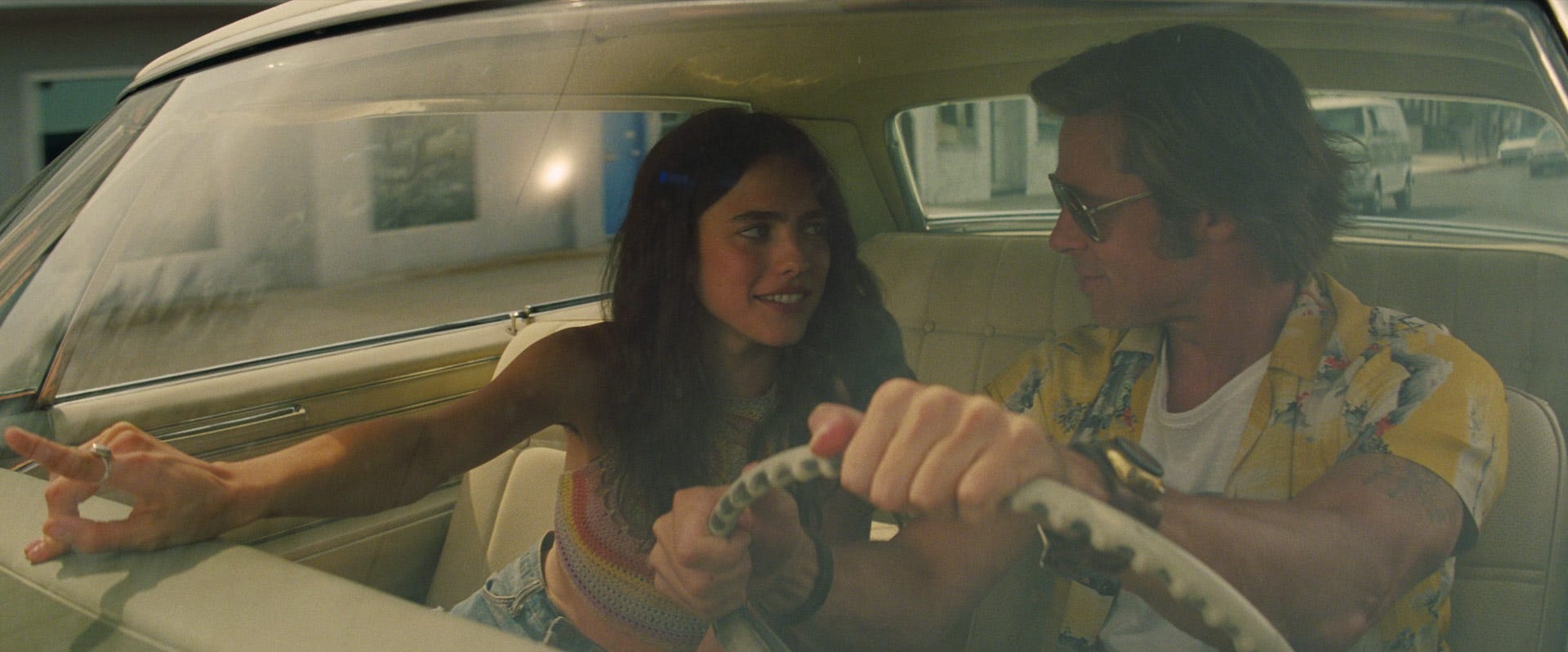
One of the girls in the book, ‘Pussycat’, who is based on a real woman whose association with Manson began distressingly young, is in the book a ‘fifteen-year-old dark-haired angel’ — the ‘beauty of the bunch’. She’s a real object in the book, in a way which seems ugly and gratuitous. Accurate to the period under discussion or not, it’s grotesque. Perhaps this is an instance in which Hollywood censorship and the limitations provided by having to choose actors are to the benefit of all. In the film, ‘Pussycat’ is played by Margaret Qualley — by any standard an acceptable dark-haired beauty. And thank goodness, at the time of the film’s release, she was 24.
Manson’s posse has taken over the ranch owned by an elderly, blind George Spahn, whose environs were used for shooting Westerns — don’t you know. George Spahn gets a nurse and mistress in redhead ‘Squeaky’, one of Manson’s girls, and the group gets a place to live and some money. It’s an uncomfortable arrangement for the reader, and for the primary agent of the book, Cliff Booth.
Booth’s a stuntman and a war hero — prime Tarantino stuff. He’s blond and he’s handsome. He got the ‘most confirmed kills’ — a grotesque and probably anachronistic phrase — of anyone in the whole damned Second World War. He won two Medals of Valor (which doesn’t exist), and keeps them in his pocket. Women find Cliff irresistibly attractive. He flirts with them with all the overconfidence of Roger Moore as James Bond. Cliff’s a film buff, and has long sections of the book dedicated to his idiosyncratic tastes — almost identical to the author’s, one can only imagine. He wears yellow Hawaiian shirts and recently murdered his wife. His dog is a tough bulldog bitch called Brandy, and at once stage she fought other dogs, and killed them, to win her owners money. It’s an odd life.
Cliff is the driver and handyman, and stunt double, for Rick Dalton, a neurotic drunk of an actor who never quite managed to make it. Sure, he had some big parts — war dramas, Westerns. But he’s a failure and on TV in guest spots, and wakes up hungover, and can’t remember his lines. At least he bought his swish house, next door to Roman Polanski’s, when he had some money. His neighbour has just moved in, with his pretty blonde wife, Sharon Tate. They’re about to have a party.
Rick’s problem is that he doesn’t know if he can make it any more. It’s a difficult life. The Italians are coming in and trying to make Westerns. The streets are full of hippies, infested with them. He still wears a pompadour. Early in the book Rick gets a talking to from an agent. He’s told that his time is up, unless he sells out precisely and quickly to the right people. He’ll never be Steve McQueen, but he could still make a good living. The future has almost arrived. It is a great and terrible thing.
Rick is the best character in the book for the simple reason that his flaws are real and obvious, and he can almost grasp them in his hands. They elude his comprehension just yet. But he is starting to understand. He sits on sets reading potboiler junk, and talks to agents and finds himself in tears. He speaks vulgarly to other actors — about homo directors, and films they didn’t ‘get’, and their short-lived marriages, and women they desire — in superficial, atmospheric ways. Everyone talks about sex in this book but no one ever seems to have any. The men never speak truthfully — it’s bluster and posture throughout. Reality only strikes when drunken chatter becomes an outburst, when banks are burst and dams break. Then cold truth rains down.
The moments where Rick really shines are those he shares with a precocious young co-star, who wants to be called Mirabella, even though she’s actually called Trudi, so she can stay in character. She needles him and presses him, and forces him to be a professional. In a surprisingly moving moment left out of the film, she asks him during a running of their lines whether he agrees that they’re actually really lucky, aren’t they?
I spent this time describing the characters because their interactions are the heart of the piece, and without them this book would fall to pieces.
Tarantino probably hates the way people compliment him for his dialogue above all things. He probably thinks that comment is cheap — that it reduces him as an artist. But it’s true in film and it’s true here. The dialogue of this book is whip-sharp, clever, surprisingly revealing, witty, laden on occasion with pathos. It makes the book immensely enjoyable, and gripping. By comparison, everything else is leaden and dull.
The descriptions are often appalling. Things are said that do not need to be referred to in passing, let alone written down at length. The book is full of awful clichés and howling, cringe-worthy adjectives. Cliff is played by Brad Pitt, wears a yellow Hawaiian and is blond, so when he’s referred to, it’s ‘the stuntman’, the ‘Hawaiian intruder’, the ‘Hawaiian guy‘, the ‘blond smart aleck’ — every single time. Rick’s co-star is an eight-year-old girl, so Tarantino calls her ‘the little eight-year-old’ (how many big eight-year-olds are there?), ‘this midget’ and so on.
Your ability to read this novel to the end, and to enjoy it, will be determined by whether you can get through passages like this (‘While the blond-haired man was storybook dashing and incredibly dignified, this new man was a devilishly handsome roguish-looking south-of-the-border-styled cowboy with a thick snatch of fudge-colored hair that framed his face in a way that Mirabella could only describe as dreamy’) without screaming and throwing the book out of a window.
(‘Pulled by six horses, the Butterfield Wells Fargo passenger stagecoach rounded the corner where the adobe-walled mission stood and thundered down the dusty dirt main drag of the Spanish-style town of Royo del Oro, sixty miles on the north side of the Mexican border in California. The hard hooves of the sweaty beasts tore at the dirt main street, creating a cloud of brown powder in their wake.’ This is the stuff Dan Brown is pilloried and parodied for doing, but worse, and more pretentious.)
Part of this could be waved away as the price of homage. Tarantino wanted to write in the style of the cheap novelisations he read as boy. He wanted to produce his own version of the same trash. It’s like using grainy, jumping filmstock to produce Grindhouse. The most obvious marker of atmosphere, period scenery.
But other things are even less forgivable. Tarantino cannot stop himself from redundant description. He describes the character of several different radio programmes on several different stations. He quotes song lyrics at length. He lists bands, directors, actors and the rest, often including little tags so we know what he thinks of them. He quotes period appropriate adverts verbatim. He criticises films and actors continually, both through the character of Cliff and just for the hell of it in the narrative proper. He justifies at length Cliff beating the shit out of Bruce Lee.
It’s the narrative equivalent of a rambling podcast interview with the author, of which we have a number for the sake of comparison — even some produced to promote this book. The interviews and the book have the same hobbyhorses, the same rush to judgement.
Some of this is funny and apt; much of it is not.
(On Kurosawa: ‘Cliff felt where the American critics got it wrong was referring to the director as a “fine artist.” Kurosawa didn’t start out as a fine artist. Originally, he worked for a living. He was a working man, who made movies for other working men. He wasn’t a fine artist, but he had a sensational talent for staging drama and pulp artistically. But even the Old Man was susceptible to falling for his own notices. By the mid-sixties, with Red Beard, the Old Man would change from Kurosawa the movie director to Kurosawa the Russian novelist. Cliff didn’t walk out of Red Beard, out of respect for his once-favorite movie director. But later, when he learned that it was how darn ponderous the Old Man became on Red Beard that prompted Toshiro Mifune to vow to stop working with Kurosawa, Cliff took Mifune’s side.’ This digression at least has a punchline.)
The reason Tarantino does this, it seems, is because he wanted to write a novel rather than a screenplay. He can write screenplays; his screenplays are good. But he wanted to write a novel. From reading this one, it does not seem that he has read many novels — not many good ones, anyway. Tarantino has seen many films and much TV. But he doesn’t want to write film scripts or TV. Novels are descriptive and so this one must be.
Tarantino has suggested en passant that he writes far too much because the stuff just pours out of him, and that his already-long films are whittled down to the bare essentials by endless gruelling rewrites. Even so, his scripts, his says, are filled with asides, the equivalent of stage directions, which he uses to build his actors into the characters who have inhabited his thoughts for years. All this description helps to create stuff — in the frame, on the soundtrack — that can be conveyed instantly on film. It does not require any wind-up, or rhetorical justification.
The book allows him to change the story, to supplement it, to make additional comments. For example, the author appears to have increased the size of Sharon Tate’s bust in moving from the screen into print. That seems an odd emendation to stress.
Tarantino’s style suits film well. It does not suit a descriptive, long novel in the slightest. Fun as this all is, it’s something he should have realised.