
The Deep Past
Egypt in the Age of the Pyramids by Guillemette Andreu

Reading this book is a vertiginous experience. The distances in time and distance are vast. One feels almost likely to fall.
Guillemette Andreu has written an approachable, and comprehensive, introduction to the deep history of Egypt — a history of the time the pyramids were built. It is necessary to explain how ancient these things are. Her book only covers the periods in which these great structures were created, before the pharaohs moved their burials into the Valley of the Kings, and dozens of centuries before the Romans came: entire millennia before many of the kings and queens whose names we know were conceived.
Rameses II, Tutankhamun, even the Bronze Age Collapse which capsized civilisation across the Mediterranean — these are all so distant from the periods under discussion that they could be as firmly separated as we are separated from the Norman Conquest. Caesar is as far from them as the writing of the Old Testament is from the modern state of Israel.
Andreu’s book exclusively concerns the Old and Middle Kingdoms of Egypt, from around 2700 BC to 1600 BC. It is an unfathomably ancient business. Andreu first generates this vast gulf — she describes a society in which the writing system is pictorial not because of the benefits it confers, as in Mandarin, but because it is that close to the emergence of written communication in humans. When Egypt itself could be reasonably considered, not a unitary state of immense longevity dominated by the inevitable pharaoh, but the relatively recent unification of two distinct societies: Upper and Lower Egypt: the Two Lands.
She writes of a nation where domestic fowl were geese and ducks, because the chicken had not yet been introduced to the Nile Delta. Rats and mice ran wild, because this period predates the domestication of the cat. And hunting is that much harder, because horses had not yet been brought to Egypt from Asia.
And yet these people were so like us in their behaviour and their actions; their achievements both monumental and wholly explicable. My sympathy, already slender, for any claim that the Egyptians could not have done the things they did has evaporated entirely. Andreu makes brilliant use of astonishingly abundant documentation — papyrus texts, inscriptions and iconography — to recreate a social atmosphere in which grave markers tell entire life-stories; functionaries boast of the things they did — the building of pyramids, the tunnelling out of precious stones and pleasing rocks, the carving of statues; but treat it also as another day at the office.
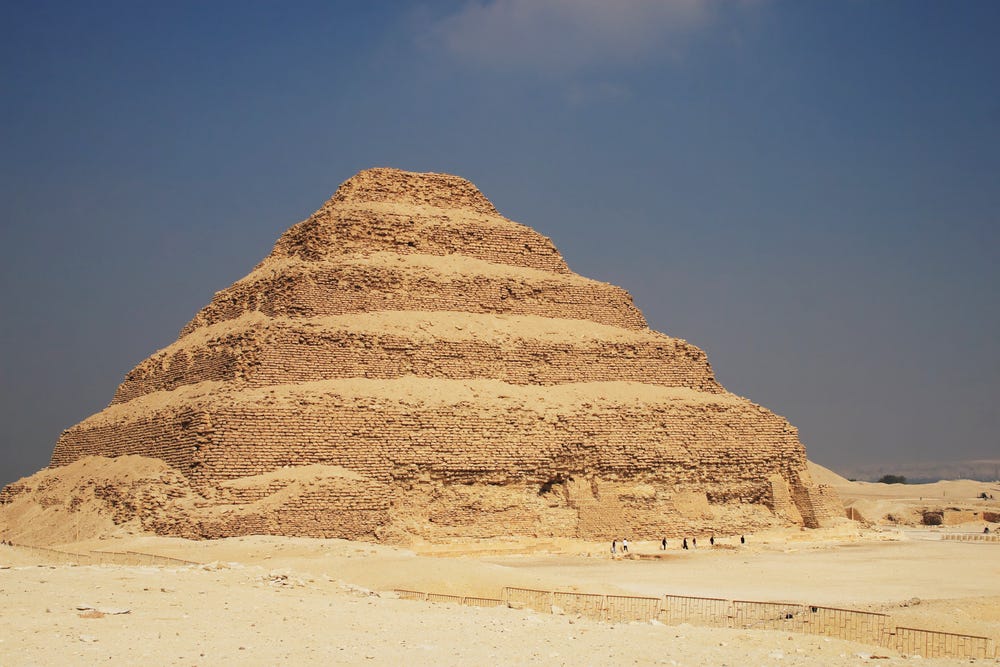
In this telling the pyramids are no great achievement once the idea to build the first one was had (by a man called Imhotep — later, much later, revered as a god, and considered to be the author of an apocryphal collection of aphorisms). The pyramids were built, in ordinary fashion by massed groups of workers levied from their ordinary work through the corvée, a kind of unpaid obligation to work. This is something which lasted in pockets of Egypt until the end of the nineteenth century — not BCE, I should stress, but 1900 years after the birth of Christ.
The pyramids are almost routine, in this telling. They were necessary for each pharaoh to have built, and they took a while, so the workers had better have set to it if they wanted the project to be ready in time.
This Egyptian civilisation had observed five planets of our solar system and had worked out that each year had 365 days. Their days had 24 hours.
No pyramid bears a signature of an architect. It exists solely as the permanent, indelible monument to the entombed; and even though its white limestone casing has not remained, polished and white, and its capstones have been looted and no longer shine — the Egyptian effort which aimed towards eternity has been achieved, at least until our own time, in these structures.
The statues the Egyptians created are a perfect distillation of their ethos — and all its sameness and difference. These statutes are stylised in pursuit of a certain kind of life-like realism destined to last, in accordance with the dictates of the gods. Their realism is often almost unsettling. Yet nothing is ever signed, all was the interchangeable work of artisans trained to create alike and in concert. The craftsmen did not work for beauty or to distinguish themselves; but rather to participate in the perpetuation of their culture.
And yet the written record is pleasingly individual. The dual pictorial and linguistic nature of hieroglyphic script meant that texts could have two meanings — the sounds of the words mirroring or playing off the connotations of the images they are built upon. It is a parallelism which leaves literary works of extraordinary, incommunicable sophistication.
There are individual ‘wisdom texts’, collections of epigrams and examples of good behaviour, quite like the dicta made popular by later Roman and Greek schools — two or more thousand years later.
There are examples of allegorical fiction we might even call novels, like the ‘Tale of the Shipwrecked Sailor’, with exotic foreign travel and the sort of perils one might associate with Odysseus or Aeneas, or Sinbad; and the fragmentary tale of ‘King Neferkare and General Sasenet’, in which a romantic relationship between the two men is implied — and implicitly condemned, for sneaking into the general’s bedroom is written up as an unduly frivolous thing for the almost-divine king to spend his days doing.
This is where the vertigo most rapidly descends.
Andreu describes both daily life and the nature of Egyptian art with a heart-wrenching present tense. The families love each other, as the wisdom books tell them they must. The men try to keep their wives in material comfort and to keep their children alive. The children who survive play in the streets; in art the little ones are depicted with distinctive hairstyles which by custom connote their age.
The yearly inundation of the Nile — now ended by a series of dams — keeps the delta fertile enough to grow the wheat for beer and bread. When the Nile does not flood, there are lean times — but, a moving assertion, in the good times in this ancient land, no one had to go hungry.
They hunt and fish by the rivers, some of the fishermen boasting, others cursing the abrasion of their nets to their hands. They sit on their porches and sleep on their reed mats, and in the evenings they savour the cool night air.
The scribes, prideful and upright, tell their sons to follow in learned footsteps, and one scribe, Dua-Kheti, writes a book for his son Pepi called ‘The Satire of the Trades’ in which, a Juvenal before his time, he critiques with sardonic flourishes the manual work he wishes his boy to disdain.
The poor ones do not have much, but men and women of all classes wear cheap jewellery supposedly possessing charms and the blessings of the gods. They work in the fields, they gather reeds, they weave and butcher animals for meat. They play with their dogs. Their potentates lead expeditions into the desert to fight or pursue raw materials. They play music on their wooden instruments and pray to their gods, and offer up prayers to the cults of their dead. They worry, though they are told by their songs to live for today, about eternity.
If the sources Andreu cites are comprehensive, the people of Egypt of this period were uniquely interested in what relics of their civilisation would survive. Cosmic order, personified as Maat, had to be sustained — harmonious society and the creation of lasting monuments to the souls of the dead did that job. They are fortunate, though they cannot know it, that the conditions in which they laboured were so propitious — the sand so effectively preserving their temples, their papyri, their bodies.
We gaze at the immensity of the pyramids, and some of us foolishly wonder if human hands could have made them, while others wonder about the lives of the workers whose cottages and burial places lie there still, not too far from the great structures upon which they worked. Some wonder if they did so complainingly, or with a pride they kept to the end.
All of this is gone now — so distant it is difficult to believe it belongs to people of the same species as us. It is difficult — in a number of ways — to remember that they were us, and we are still like them.