
Their Youths Given to War
Martyrs' Brigade by Sakir Khader

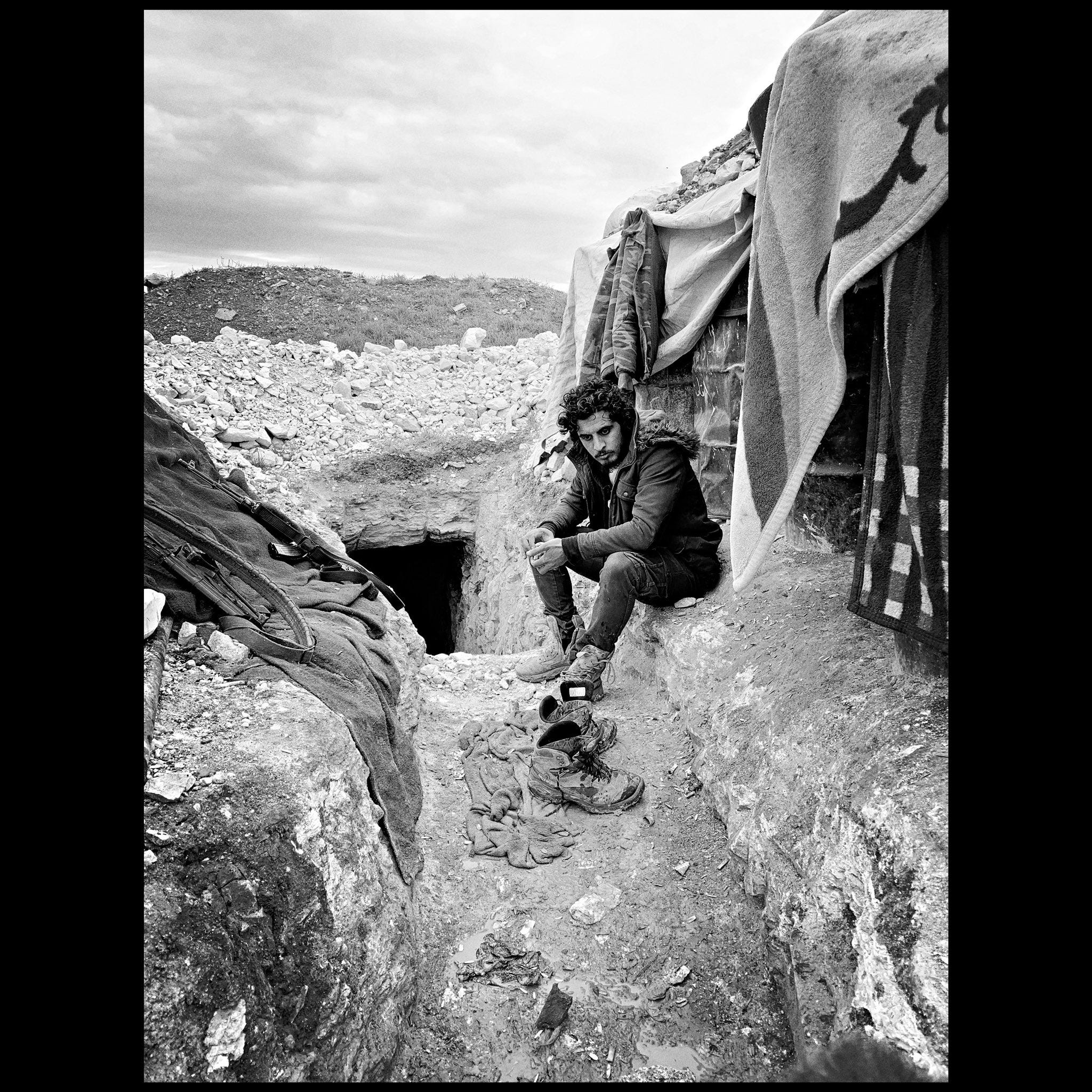
This is one of those books which raise an involuntary shudder. A shudder not of fear, but of grim recognition. The dusty fields. The broken glass. The way every building seems holed and unprotective. The sights of Syria’s long, unending war. Unmistakable to one who has followed the conflict — unforgettable, too, even if you think you’ve got over it and have other things more front of mind.
The photographer Sakir Khader followed the Martyrs’ Brigade, an independent Syrian rebel faction, as it scrambled in the winter of 2018-19. The glory days of Homs, capital of the revolution, when the town was electrified by Abdelbasset al-Sarout, later the group’s leader, were by that time long gone. International support had long dried up. The Russians had come. And ISIS had disfigured the war and monopolised international attention.
On the front lines of Idlib and Hama, this small detachment stood its ground against a regime coalition whose ranks were swelled with Russian special forces and Iranian-assembled militiamen. In a war where few, if any, fighters are elite, courage and technological superiority are essential. The rebels had courage, but their opponents were better armed. Being better armed generally wins the day.
It was a hard winter. ‘Often, we did not know where the enemy was’, Khader writes in his introduction.
I have written much about Sarout, his life, death and legend, and will doubtless write more again, so I will only say here that some of the pictures of him in this collection are among the most remarkable, and the most wrenching, that I have seen. We see him in his winter, physically and temporally. He was to be killed shortly after these were taken. I reproduce above a photograph Khader posted to Twitter and which features in the book. Look into his eyes.
The rest of the book is of the same quality. Monochrome which could have been moody and stylish is in this collection essential and documentary. Things begin with breathtaking overhead shots of clustered settlements — Homs, Hama, Ziliqiat, Masasneh — petering out amid darkly represented green.
There are some older men with careworn faces.
But more individual shots show these youthful fighters posing with their antiquated weapons. Some of the boys among them stand singly, old beyond their years, but so young. The captions identify that many of them, born around or after the millennium, did not survive 2019. In some of the pictures they wear bandanas and balaclavas before this or that operation — they hold their weapons in the ways the older men might have taught them. They stare hard into the camera.
Abu Bakr (2001-2019) covers almost all of his face. He is wrapped up warm. Faouri (1998-2019) stares off rightward into the distance, his gun slung over his shoulder. In the middle of the road where he stands, he is framed by hardy trees. In another shot he sits behind the bars of a stationary motorbike while another fighter rides pillion. Faouri smiles and points upward. Abu Mohammad (2002-2019) stands, in another picture, in the centre of a group of his fellows. They all stare coldly at the camera. Of the two of them holding rifles, only he knows to keep his finger straight, off the trigger.
The landscape they inhabit is dry and inhospitable, largely absent other people; but it is beautiful. In its earth they tunnel and build fortifications. It is where many of them must now be buried. On the minarets and mosques of these cities the plaster flakes, and the walls of houses are pitted with bullets, firing holes and collapsed brickwork. Scrubby greens persevere around unmaintained roads and unsettled streets.
Windscreens are cracked and cars and motorbikes are utilitarian machines, dirty and careworn.
In several shots, fighters pile into pickups and flatbeds, off to the front, perhaps. There is determination on their faces, but they seem too ill equipped to be allowed to go. Elsewhere they sit in courtyards and light cigarettes. They sometimes smile, but weariness pervades them. Perhaps it’s the need to be warily on guard at all times.
Khader describes a drone attack in which his life was saved by the quick thinking of Hussein Mohammad al-Homsi (1996-2019), to whom the book is, in part, a memorial. In his portrait, al-Homsi stares straight at the camera and his eyes glitter and reflect the light.
One of the most dizzying shots of the collection is taken through a rifle scope. In the dead centre of the frame, all is sharp and magnified, the target over a languid man walking past, or perhaps shepherding, some sheep. The rest of the frame is ablur and hazy, only the gunsight seeming clear.
Khader notes that for these young men, who have known only war, they have endured great defeat. The survivors of Sarout’s band regrouped in the enclave still free from regime control in the northwest. Some of them have fought in Libya, at Turkish instigation.
One can only forlornly hope, having stared into their faces, that they and their country might find peace.