
True Romance
The Traveller's Tree by Patrick Leigh Fermor

It is remarkable that The Traveller’s Tree was Paddy Leigh Fermor’s first book, at least judging by its breadth and beauty.
This is an idiosyncratic and surprisingly comprehensive survey of the Caribbean written at the beginning of the 1950s, just before the islands transmuted into postcolonial independence. It is a record of a surprisingly transitory time.
The islands could not have commanded a better writer than Leigh Fermor in this moment of transition. Although he is perhaps best thought of as a man in love with old Europe — captivated by its intricacies and obscurities, a champion of its peasant cultures, adept with many of its languages — in this volume, he is as keen to discuss the finer points of Haitian art and Jamaican town planning as he is, in other books, to break into Greek verse or recall en mémoire a French song.
The book discusses in great and striking detail Leigh Fermor's travels across the island chain, accompanied by his partner, and later wife, Joan; and by Costa, a Greek photographer and illustrator (who also appears, unless I am mistaken, in a supporting role in books by other travel writers in the fifties and sixties).
They go everywhere, by aircraft and by boat, with Leigh Fermor remarking sadly upon little islands in the stream he has no time to visit. They stop in every major settlement that matters, and a number of out-of-the-way ones. They see as much as possible, even as they rush across the Atlantic towards the Main.
Some of the reviewers who saw this book first grasped the emergence of a fresh talent, and so on. But others of them, more perceptively, understood that this was also the creation of a great romantic sensibility. It's in evidence in Leigh Fermor's only novel, The Violins of Saint-Jacques, also set in the Caribbean, not his own age, but rather the recent, romantic past. A past of native Caribee aristocrats who spoke French with creole lisps, and great flowing ball gowns, love affairs carried out by letter, and fireworks. Including the tragic ending, it's a little like a more rhetorically elaborate song from Fearless-era Taylor Swift — heady stuff — and charming for it. (Not unlike a pop music video from the first decade of this century, in Leigh Fermor's telling, everyone he encounters in this book appears either to be strikingly pretty or to have an interesting face.)
Returning to travel, Leigh Fermor's romanticism goes further. He does the usual tricks of the romantic — summoning scenes of pageantry and peril from memory; resurrecting doomed settlements and deposed emperors in his mind's eye; imagining great colour and movement.
All of this could be cloying if not for two things.
First, the research Leigh Fermor delights in doing. He has read, it seems, virtually everything on each of the islands he encounters, in several languages, and makes pointed continual reference to the early European chroniclers of the Antilles. For Leigh Fermor, Père Labat, a sixteenth century Jesuit who left voluminous ethnographic writing on the subject, is referred to throughout like a dear friend. Trips to new towns and cities are continually interrupted by Leigh Fermor's slinking off to libraries and antiquarian societies, where he tries happily to substantiate the colour of earlier historical writings. (One successful example is the remarkable charting of the journey that took a Palaeologus, the descendent of Constantine XI, the last emperor of the Romans at Constantinople, from Greece to England, to rest in a Caribbean churchyard.)
There is a lot of history, entertainingly told, in this book. It's often violent or tragic enough to allay charges of peddling cotton-candy nostalgia.
Second is the sheer unpatronising attentiveness with which the author addresses local customs. He is interested in everything and little avoids his attention. These customs are rarely quaint or amusing, or primitive. Instead, each presents a point of interest. 'Saga boy' dandyism, for example, or Voodoo ritual in Haiti, which is perhaps given a little more coverage than it necessarily merits. Leigh Fermor enjoys the art of the 'Haitian Renaissance' and the cooking of the Maroons in Jamaica's highlands. His most severe judgements are reserved for people who try to cheat him and his party — and for the new custom of consuming Coca-Cola, something he no doubt considers a harbinger of boring, American-flavoured homogenation.
Both the imported black population of the islands, and the native 'Caribs', now called Kalinago, are given a chance to talk. The author enjoys their customs, unspokenly envies their lifestyles, and wishes them the best. He dislikes — pointedly — tacit or illicit examples of the 'colour bar' still present in these dying colonial days; and he makes clear that the region's great stain is that of slavery.
But this book is never didactic. It is open-minded and jovial. Leigh Fermor plays along, and is eventually convinced, when a local man claims he can dowse with a pair of divining rods for buried Spanish gold.
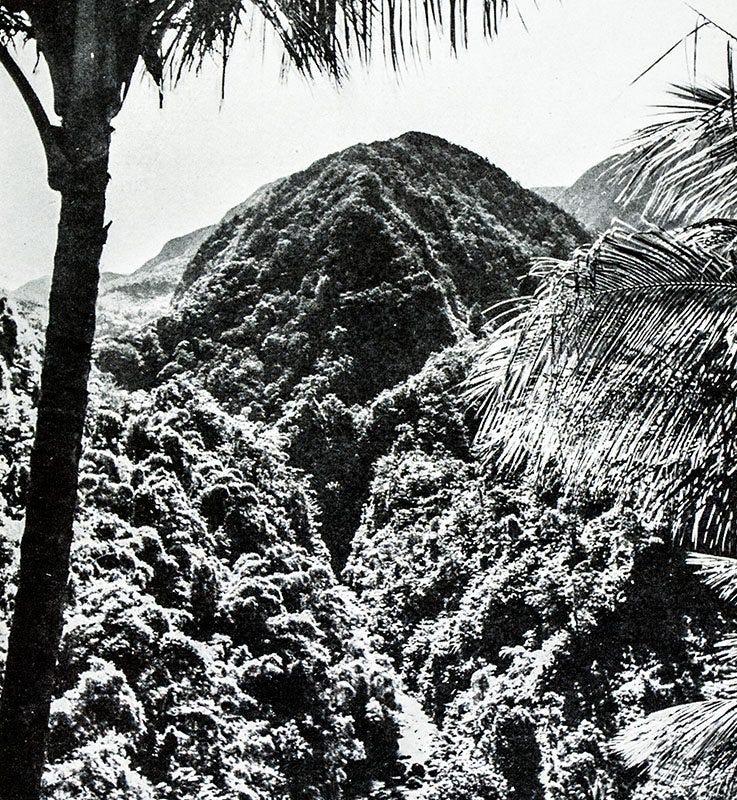
Leigh Fermor is good at landscapes. Bays and glades, and mountains and cities, are rendered real in his description. Forest clearings are dappled with light. Storms rattle ships' ropes and sails, and fog imperils air travel.
And when he describes napping under a particular tree, as happens more than once, he does so each time with enough differences in detail and ambience to separate each instance.
That image might be appropriate — parts of the book feel a little dreamy, with each new sensation approaching the reader's eyes like a brightly-patterned dress blowing closer on a washing-line.
But enough remains of substance to give the ride some rigid, tensile strength. Good fun, and with enough excess fluff to flavour a novella.